Agentic SDLC

For 25 years, Critical Software has engineered systems where failure is not an option — in aviation, defence, rail and finance. That's the discipline we bring to this. Not consulting on strategy. Not a tool license. A working system, delivered.

sdlc-images-cover_global-website-1

AI makes software fast. We make it dependable.

The traditional SDLC was built around human throughput — sequential phases, handoffs, waiting for the next gate. That model made sense when humans were the bottleneck. They aren't anymore. A sprint's worth of code now takes an afternoon. A quarter's worth takes a week. But approval gates, review cycles, and team structures haven't moved. Most of the productivity gain disappears in that gap.

The organisations seeing returns haven't just added AI tools to what they already do. They've changed how software gets made: shorter cycles, AI handling the volume work, humans making the decisions that require judgement. That shift needs different tooling, a different governance structure, and a partner who has already built and run both. That's what we do.
The real problem

Most organisations are paying for AI and still running the old model.

The paradox
88% of organisations use AI. Only 5.5% are seeing financial returns.

The technology isn't the problem. Most organisations have added AI to processes that weren't designed for it, and the returns reflect that. (Source: McKinsey & Company, State of AI 2025)

The shift
Speed is no longer the constraint.

Coding is faster. The bottleneck is now coordination, review cycles, and decision overhead. Fixing only the code pipeline while leaving everything else unchanged just means work piles up somewhere else.

The risk
Faster output without governance is a liability.

AI-generated code, hallucinated requirements, missing validation evidence, lack of traceability, undocumented decisions: at scale, these add up. In regulated industries, one compliance failure costs more than a year of AI-assisted delivery saves.

The answer
The shift that produces returns.

AI agents generate, test, monitor, iterate. Humans set direction, govern risk, and step in on decisions that matter. That's the model. And it's one Critical Software has already put into production.

What changes

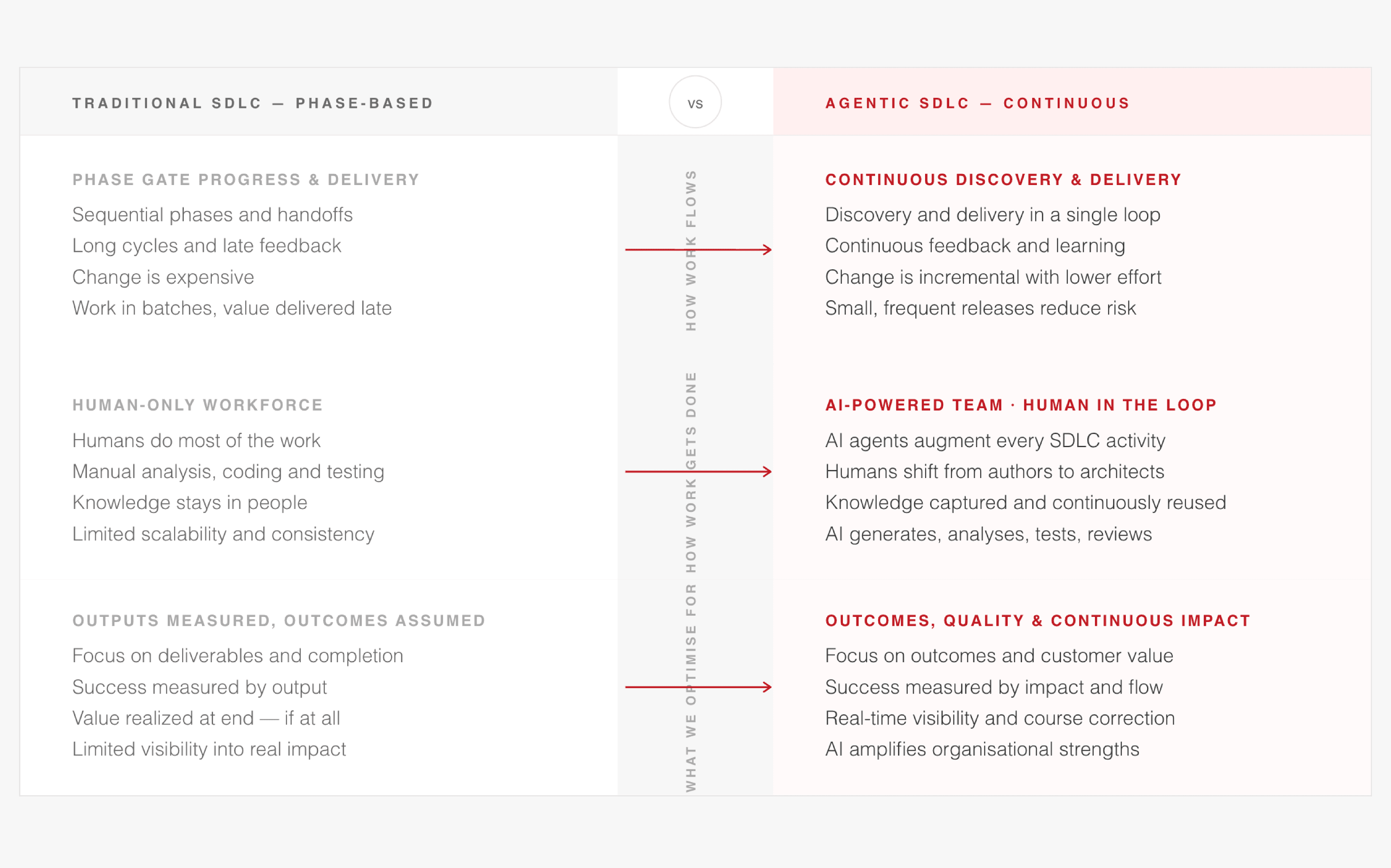
Three structural shifts — not incremental improvements.

Most organisations have added AI tools to a delivery process that hasn't changed since Agile. The gains are real but limited. What changes when you redesign the process itself is visible across three dimensions.

imagem-2-sdlc
The new paradigm

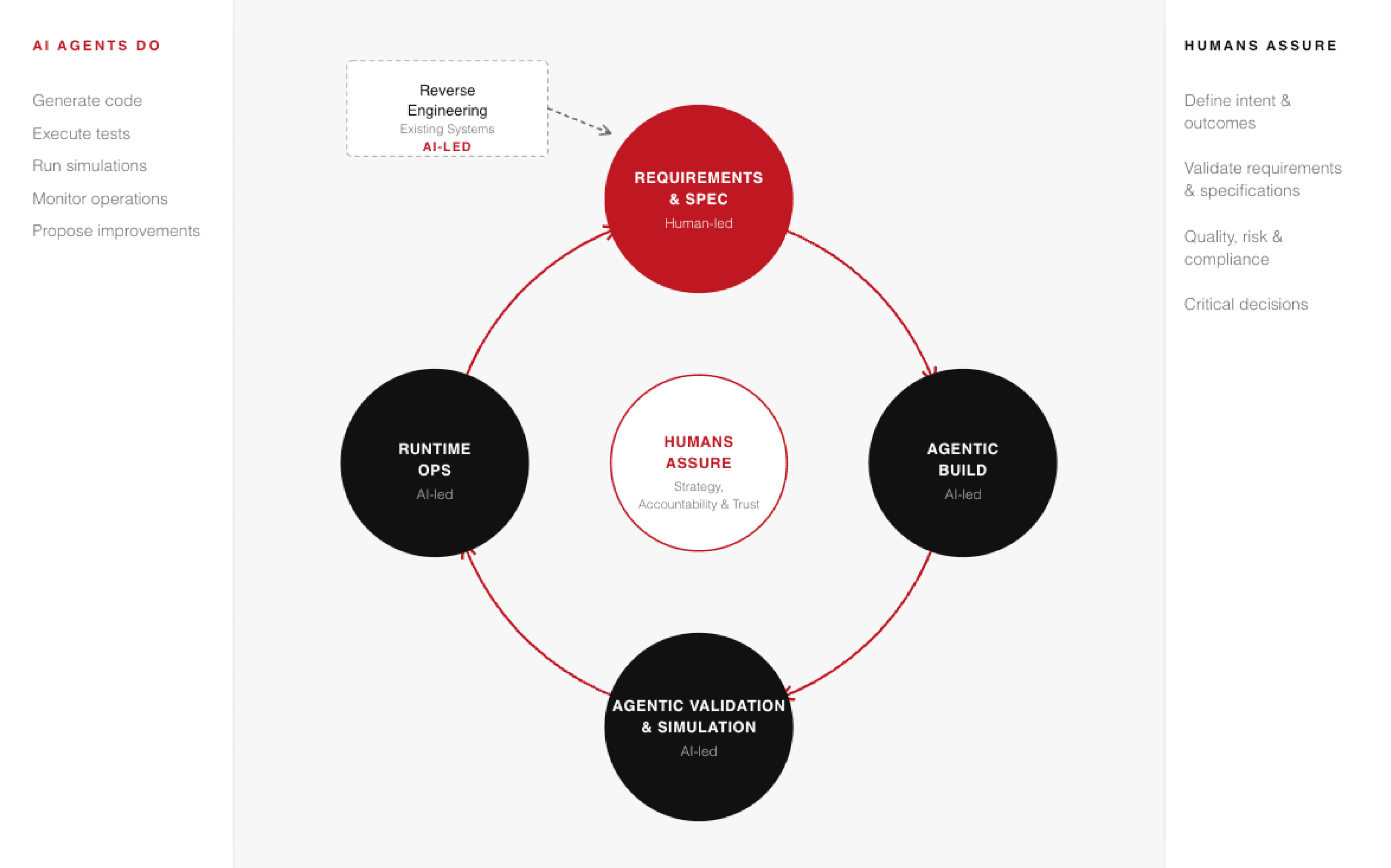
AI agents execute. Humans assure. That division of responsibility is the operating model.

In practice: AI agents run the full lifecycle — generating, testing, deploying, monitoring. Engineers stop being the people who write everything and start being the people who decide what gets built and whether it's right.

imagem-1-sdlc
Our approach

Three pillars. One shared foundation. A clear path from discovery to delivery.

Understanding the right problem before building the solution.

AI analyses data, documents and feedback continuously to surface opportunities and risks. Human and AI co-create the solution backlog, validated in real time with users and stakeholders. Discovery doesn't end when execution begins. It runs in parallel, feeding new insight back into the process throughout.

The tools

Built on domain expertise. Validated on real systems.

Legacy modernisation
Cobot

Helps organisations understand and modernise legacy codebases — translating 400+ lines of COBOL to Java in under a week, with an 80% first-attempt test pass rate.

Discovery
Backlight

Extracts a validated functional blueprint from a running application. No source code or documentation required. Turns the most opaque legacy systems into a structured, human-readable specification in days, not months.

Agentic delivery
Tectonic

Takes system understanding and converts it into an executable plan-and-build workflow. Bridges the gap between understanding what a system does and actively evolving it, removing the manual re-architecture phase that stalls most programmes before they produce value.

Requirements
IBE

Ingests regulatory documents, business requirements and policy files and returns structured, actionable intelligence. Cuts the time from regulatory change to implementation-ready specification from weeks to hours.

How it works

A clear path from first conversation to first production outcome.

We structured the engagement so you can validate the approach against your own systems before committing to a programme. No open-ended discovery. No runaway scope.

30 minutes

We understand your delivery context — what you are building, where the friction is, and what a better outcome looks like. We identify which accelerators apply and give you a concrete view of what 90 days produces. No slides, no pitch.

Why Critical Software

25 years engineering systems where failure is not an option. That is not a credential. It is a constraint that makes us build differently.

We treat AI transformation as an engineering problem, because that's what it is. Audit trails, compliance constraints, traceability from decision to deployment — these aren't features we add at the end. They're how we build. That comes from 25 years in environments where a missed requirement has consequences well beyond a missed deadline, and it carries into every engagement we run.

When we leave, the tools stay in your environment. The decisions made during the engagement are captured in the Living Spec. The knowledge doesn't walk out with the team.

The organisations that will get lasting value from AI are the ones that redesign how software gets made, not just how fast it gets written. That redesign touches team structure, governance model, definition of done, and how decisions get recorded.

We don't skip that work. We've done it in environments where getting it wrong is measured in safety incidents and regulatory fines. That's what we bring.

01

Every automated action is auditable. We build it that way from the start.

Security, compliance and traceability are designed in from day one. In regulated industries this is non-negotiable. In every other industry it's still the right way to build.

02

The knowledge stays when we leave.

Our Living Spec captures intent, decisions and rationale from the first conversation to the last deployment. It's in your systems, your tooling, and your team — not in a consultant's head.

03

We agree what success looks like before we start — then we measure it.

Cycle time, effort reduction, cost per outcome — we agree the metrics upfront and track them throughout. You should know whether the investment is working before the programme review, not at it.

04

The tools are specific because the problems are specific.

Cobot is built for legacy code comprehension. IBE is built for regulatory language. Backlight is built for extracting structure from systems with no documentation. Generic tools produce generic results.

Start here

30 minutes. A specific answer for your context.

Tell us what you're trying to deliver and where it's getting stuck. We'll tell you specifically what we'd do, which tools apply, and what 90 days looks like in your context.